
VAN GOGH MUSEUM HISTORY
About Van Gogh Museum
The Van Gogh Museum in Amsterdam is dedicated to the life and art of the legendary Dutch painter Vincent van Gogh. It has the largest collection of his paintings, drawings, and letters, including over 200 paintings and 500 drawings. The museum’s collection is organized into five main periods of Van Gogh’s life: Nuenen (1880-1885), Antwerp (1886), Paris (1886-1888), Arles (1888-1889), Saint-Rémy (1889-1890), and Auvers-sur-Oise (1890). The museum, which has a permanent collection and hosts temporary exhibitions, opened in 1973 and is one of the most visited museums in the world.

Van Gogh’s art and influence
Van Gogh’s Museum offers visitors a journey through Van Gogh’s world through his famous paintings, such as “Sunflowers”, “The Bedroom”, and “The Potato Eaters”, as well as his letters and drawings. These pieces show his artistic growth and the inner struggles and emotions he experienced, such as hope, love, distress, and pain. The popular museum also highlights how Van Gogh inspired later artists, like Maurice de Vlaminck and Kees van Dongen. It includes nine self-portraits and some of his earliest paintings from 1882.
Artworks by Van Gogh’s contemporaries
In addition to Van Gogh’s work, the museum displays paintings and sculptures by other artists from the Impressionist and Post-Impressionist movements. This includes works by Paul Gauguin, Claude Monet, Henri Toulouse-Lautrec, Édouard Manet, and Georges Seurat. The collection also includes sculptures by Auguste Rodin and Jules Dalou, offering visitors a broader look at 19th-century art.

Vincent van Gogh: Early years
Vincent van Gogh was born on March 30, 1853, in the village of Zundert, Netherlands. He grew up in a large family in Brabant and finished primary school before leaving at age 14. At 16, he left home and, with help from his uncle, started working as an apprentice at the art dealership Goupil & Cie. In September 1872, he began a lifelong correspondence with his younger brother Theo, who joined Goupil in Brussels in 1873. That same year, Vincent was transferred to Goupil’s office in London.
Searching for the life purpose
Vincent van Gogh spent several years searching for his direction in life. He tried various jobs as an art dealer, teacher, and lay preacher, but none fulfilled him. During this period, he grew more interested in religion and art and moved to Belgium to work in the poor mining community as a lay preacher, helping miners but struggling to build a close religious community. Encouraged by his younger brother Theo, he decided to pursue art. At the age of 27, Vincent made the decision to become an artist and began to draw seriously in 1880, moving to Brussels to study and connect with other artists. His brother Theo played a crucial role in guiding him. Although he had no paid work, Theo continued to support him financially.

The Potato Eaters
Vincent returned to his parents’ home in Nuenen in 1883, focusing on painting farm life and creating works like “The Potato Eaters”. Although he worked hard, his dark style wasn’t popular in Paris. He wanted to grow as an artist and moved to Antwerp in 1886 to study at the art academy, but he didn’t appreciate its traditional methods and considered them too restrictive. He then relocated to Paris and started studying under popular artist Fernand Cormon. He began experimenting with color and modern styles, marking a major shift in his art.
Vincent’s time in France
In Paris, Vincent van Gogh developed his own distinctive style and started using vibrant, bright colors and short brushstrokes. He was influenced by modern artists like Claude Monet, Henri Toulouse-Lautrec, and Emile Bernard. His subjects changed from dark scenes like The Potato Eaters to brighter ones, including cafés, boulevards, and flower still lifes. He was also inspired by Japanese woodcuts, which inspired him to use bold lines and colors. After two years, Vincent grew tired of the busy city life and moved to Arles in February 1888, seeking peace and inspiration in the countryside.

Struggles with mental health
Vincent van Gogh spent a whole year at the Saint-Rémy psychiatric hospital. Despite struggling with his mental health, he was very productive, creating around 150 paintings. During his better days, he painted in the garden and was later allowed to work outside the hospital. He also copied famous artists like Rembrandt and Millet. His mental health often worsened, and at one point, during a crisis, he ate oil paint and was only allowed to draw. Still, he kept working, hoping time and patience would help him heal. In April 1889, Theo married Johanna Bonger, and in January 1890, Vincent was informed that they had named their baby son after him: Vincent Willem van Gogh. To celebrate, Vincent painted Almond Blossom and sent it as a gift for the baby.

1890 – Vincent’s last year
In early 1890, the Belgian artists’ association Les Vingt exhibited six of Vincent van Gogh’s paintings at a group exhibition in Brussels. One of these paintings, “The Red Vineyard”, was sold, and he received a positive review. Theo also submitted Vincent’s work to the Salon des Indépendants in Paris in 1888. In March 1890, ten of Vincent’s paintings were displayed there, receiving a positive response.
In his final months, Vincent van Gogh lived in Auvers-sur-Oise, focusing on painting with support from Dr. Paul Gachet. His famous Sunflowers series was created during his time in Arles. He hoped to create an artist community in the peaceful village of Arles, and Theo convinced his artist friend Paul Gauguin to join him. Vincent and Gauguin worked in harmony for a while, but tensions soon rose between them. After a heated argument with Gauguin, Vincent cut off part of his ear. He then admitted himself to an institution again and continued painting.
In July 1890, after hearing that Theo was considering a risky business move, Vincent became anxious and returned to Auvers feeling depressed and uncertain about his future.
Later that month, at the age of 37, Vincent van Gogh took his own life. Despite finding some peace in painting and nature, his ongoing struggles with mental health and anxiety about the future became overwhelming. His brother Theo, who had been a constant source of support, was devastated by his loss. Vincent left behind over 850 paintings and nearly 1300 drawings.

After Vincent: The birth of the Van Gogh Museum
After Vincent van Gogh passed away in 1890, his brother Theo inherited his artwork. When Theo passed away six months later, his widow, Johanna van Gogh-Bonger, took care of the collection. Johanna promoted Vincent’s art by selling some pieces and keeping others. After her death in 1925, the collection passed to her son, Vincent Willem van Gogh. It was loaned to the Stedelijk Museum in Amsterdam for many years, and in 1962, it was moved to the Vincent van Gogh Foundation, set up by the Dutch government.
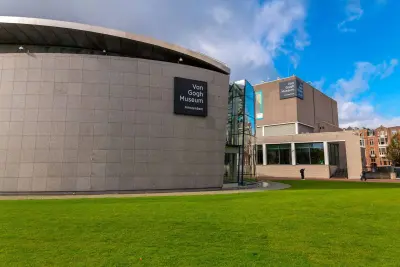
In 1963, the Dutch government commissioned architect Gerrit Rietveld to design the Van Gogh Museum. Rietveld passed away in 1964, and the museum was completed in 1973. Martien van Goor renovated it in 1998 and 1999, and Japanese architect Kisho Kurokawa added a new wing. The museum closed for more renovations in late 2012, and 75 works were displayed at the H’ART Museum during this time.
Art thefts
In September 2013, the Van Gogh Museum presented “Sunset at Montmajour”, a long-lost painting that had been mistaken for another artist’s work and eventually found. It was the first full-size Van Gogh painting discovered since 1928, created on 4 July 1888.
In 1991, twenty paintings, including “The Potato Eaters”, were stolen but quickly recovered just 35 minutes later. Some, like “Wheatfield with Crows”, were damaged, and four men, including two museum guards, were convicted. In 2002, two paintings were stolen, and after offering a €100,000 reward, they were recovered in good condition in 2016 from a villa in Italy.
Want to explore the life and art of Vincent van Gogh?

Crowd-free experience
Van Gogh Museum Small-Group Tour
Discover van Gogh's paintings and learn about the artist's life with an expert guide and skip-the-line access! This is a small-group tour, perfect for anyone looking for a more intimate experience away from a big crowd. It also means you will be able to hear your guide clearly, and they will have the time to answer your questions. Learn how van Gogh decided to become a painter at 27, how his "Sunflowers" were painted with only three shades of yellow, and more!

Flexible route
Van Gogh Museum Private Tour
Experience The Van Gogh Museum with a private tour tailored just for you. Enjoy personalized attention from your expert guide and explore Van Gogh's most iconic paintings. Learn about the techniques and background behind his famous masterpieces like "The Potato Eaters" and "Sunflowers", and get insight into his personal struggles and correspondence with his brother Theo. Uncover Van Gogh's legacy and his impact on modern art and culture.